

해빙 신호 뒤에 숨은 중국의 계산
[최보식의언론=최보식 편집인]
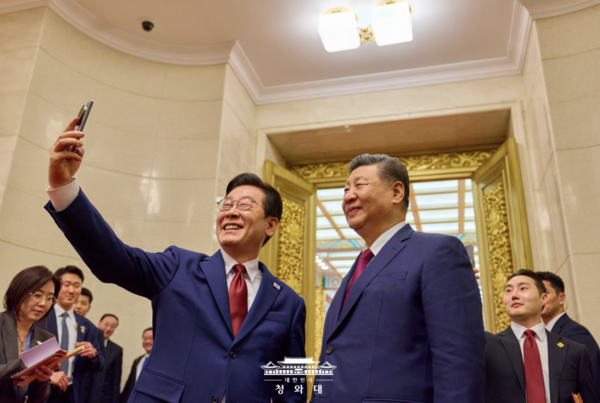
약 9주 만에 두 번째 정상회담에서 만난 한중 두 정상은 셀카 촬영 등 친밀한 모습을 연출하며 2026년을 관계 전면 복원의 해로 선언했다. 14건의 협력 MOU도 체결했다.
싱가로프의 대표적인 영문 종합 일간지 더 스트레이츠 타임스(‘The Straits Times)는 6일 '시진핑–이재명 정상회담, 관계 해빙 신호… 일본·미국 향한 전략적 메시지(Xi-Lee summit signals thaw in relations, sends strategic message to Japan, US)'라는 제목의 기사에서 한중 정상회담을 "해빙 신호 뒤에 숨은 중국의 계산"이라고 평가했다.
이 신문은 "중국의 시진핑 국가주석은 좀처럼 셀카에 등장하지 않지만 이재명 한국 대통령의 요청에 따라 국빈 만찬이 끝난 뒤 흔쾌히 함께 셀카를 찍었다"며 "두 정상의 셀카 사진은 중국 소셜미디어 웨이보에서 화제가 됐고, 많은 네티즌들이 이 대통령이 중국 스마트폰을 사용한 점을 칭찬했다"고 말했다.
이어 "중국의 한 네티즌은 '샤오미에 새로운 브랜드 홍보대사가 생겼다'고 농담했다"고 전했다.
이 신문은 "분위기상 두 정상의 새롭게 가까워진 모습 이면에는, 일본과의 갈등 및 미국과의 경쟁이라는 중국의 보다 넓은 전략적 계산이 깔려 있다"고 분석했다.
아래는 더 스트레이츠 타임스의 6일자 기사 전문이다. (편집자)
중국의 시진핑 국가주석은 좀처럼 셀카에 등장하지 않는다. 그러나 이재명 한국 대통령의 요청에 따라, 시 주석은 1월 5일 베이징 인민대회당에서 이 대통령을 위한 국빈 만찬이 끝난 뒤 흔쾌히 함께 셀카를 찍었다. 이어 두 정상은 배우자들과 함께 또 한 차례 사진을 촬영했다.
셀카를 찍은 뒤 시 주석은 “사진 찍는 솜씨가 나쁘지 않네요!”라고 농담을 던지기도 했다.
이 대통령이 사용한 휴대전화는 2025년 11월 1일 경주에서 열린 아시아태평양경제협력체(APEC) 정상회의 계기에 열린 첫 정상회담 당시 시 주석이 선물한 샤오미(Xiaomi) 모델이다.
1월 6일, 두 정상의 셀카 사진은 중국 소셜미디어 웨이보에서 화제가 됐고, 많은 네티즌들이 이 대통령이 중국 스마트폰을 사용한 점을 칭찬했다. 한 네티즌은 “샤오미에 새로운 브랜드 홍보대사가 생겼다”고 농담했다.
이번 두 번째 정상회담은 첫 회담 이후 불과 9주여 만에 열렸다. 양국 관계가 최근 몇 년간 냉각돼 왔던 점을 감안하면 이례적으로 짧은 간격이다.
이 대통령은 2026년을 “한·중 관계 전면 복원의 해”로 선언했고, 시 주석은 “더 빈번한 교류와 긴밀한 소통을 이어가겠다”고 약속했다.
분위기상 두 정상의 새롭게 가까워진 모습 이면에는, 일본과의 갈등 및 미국과의 경쟁이라는 중국의 보다 넓은 전략적 계산이 깔려 있다는 것이 전문가들의 분석이다.
워싱턴 소재 '조지 부시 미·중 관계 재단'의 이성현 선임연구위원은, APEC 회담 직후 다시 정상회담이 열린 시점이 “우연이 아니며, 분명히 일본을 향한 메시지”라고 말했다.
이는 일본의 다카이치 사나에 총리가 2025년 11월 중국이 대만에 무력을 사용할 경우 일본이 군사적으로 대응할 수 있다는 취지의 발언을 하며 촉발된 중·일 간 갈등을 가리킨 것이다.
이 대통령의 중국 방문은 12월 30일에 발표됐으며, 1월 4일 출국을 불과 며칠 앞둔 시점이었다.
또한 이번 방문은 일본 나라(奈良)에서 예정된 다카이치 총리와의 정상회담 직전에 이뤄졌다는 점에서 시기적으로도 절묘하다. 일본 언론은 양국 정상의 회담이 1월 13~14일 열릴 것이라고 보도했으나, 공식 확인은 아직 없다.
이성현 연구위원은 시 주석이 전형적인 ‘차별화 전략’을 구사하고 있다고 분석했다.
“도쿄와 일본 국민에게 전달되는 메시지는 분명합니다. 관여와 협력은 존중과 실질적 혜택을 낳고, 봉쇄는 거리감을 초래한다는 것이죠.”
“시 주석은 서울의 실용주의를 부각시켜, 이재명–다카이치 회담을 앞둔 분위기 속에서 일본의 접근법을 경직된 것으로 보이게 만들려 하고 있습니다.”
이 대통령의 4박 5일 일정은 2019년 이후 첫 한국 대통령의 중국 국빈 방문이다.
한·중 관계는 2017년 한국이 사드(THAAD) 미사일 방어체계를 배치한 이후 중국의 반발로 냉각됐다. 이전 윤석열 보수 정부 시기에는 미국과의 동맹 강화를 추구하면서 긴장이 지속됐다.
반면, 이 대통령이 이끄는 진보 정부는 전통적으로 보다 친중적인 접근을 취해왔다.
1월 5일 회담에서 시 주석은 일본을 겨냥한 듯, 80여 년 전 일본 군국주의에 맞서 싸운 한·중 공동의 역사를 언급하며 “역사의 올바른 편에 서서 올바른 전략적 선택을 하자”고 한국에 촉구했다.
이 대통령은 이에 대해 "제2차 세계대전 당시 양국이 국권 회복을 위해 함께 싸웠으며, 한·중은 “떼려야 뗄 수 없는 상호 이익적 동반자 관계”라고 응답했다.
아산정책연구원의 이동규 연구위원은, 시 주석의 발언이 한국이 일본에 맞서 중국의 입장을 지지하길 바라는 신호라고 분석했다. 다만 그는, 이재명 정부가 중재자 역할의 유혹에 빠지더라도 일본과의 대화에서 중국의 입장을 대변하는 것으로 비쳐서는 안 된다고 경고했다.
중국 저장공상대 동아시아연구소의 장광신 부교수는, 중국이 미·중 경쟁 속에서 안보는 미국에 의존하면서도 경제적으로는 중국에 깊이 얽혀 있는 한국의 “좁은 공간”을 인식하고 있다고 말했다.
그러나 그는 보호무역이 강화되고 역내 안보 환경이 불안정해지는 가운데, 중국이 한·중 관계에 대해 분명한 기대를 갖고 있다고 덧붙였다.
시 주석은 회담에서 양국이 모두 세계화의 수혜자라며, “보호무역에 반대하고 진정한 다자주의를 실천해야 한다”고 말했다.
장 교수는 “한국이 어느 편도 선택하지 않는 실용 노선을 유지하고 상호 이익과 윈윈을 우선시한다면, 안보와 경제 양 측면에서 모두 이득을 얻을 수 있을 것”이라고 분석했다.
정상회담에서 양국은 산업 교류, 기술, 환경 분야 협력을 포함한 14건의 양해각서(MOU)를 체결했다.
이 대통령은 삼성전자, 현대자동차그룹, SK그룹, LG그룹 등 주요 대기업 총수들을 포함한 약 200명의 경제사절단과 동행했다.
이번 방문을 계기로 9년간 중단됐던 한·중 비즈니스 포럼도 재개됐으며, 이 대통령은 시 주석과의 회담에 앞서 포럼에 참석했다. 그는 개회사에서 제조업 협력 확대와 문화 콘텐츠 교류 강화를 촉구했다.
중국은 21년 연속 한국의 최대 교역국으로, 연간 교역 규모는 약 3,000억 달러에 달한다.
이성현 연구위원은 시 주석이 4월 예정된 도널드 트럼프 미국 대통령의 방중과 11월 미국 중간선거를 앞두고 이번 회담 시점을 잡았다고 분석했다.
“장기화된 미·중 경쟁 속에서 시 주석은 그 시점이 오기 전에 주변부를 안정시키려 하고 있습니다.”
“특히 공급망 분야를 포함한 14개 협력을 지금 확정함으로써, 서울을 잠재적 협상 카드로 활용하려는 워싱턴의 선택지를 줄이려는 외교적 방화벽을 구축하는 셈입니다.”
그러나 협력 약속에도 불구하고, 한국이 중시하는 북한 문제와 서해(중국명 황해) 구조물 분쟁에서는 진전이 거의 없었다.
이화여대 라이프-에릭 이즐리 교수는 “한국의 외교적 노력에도 불구하고, 중국은 해양 분쟁이나 북한의 핵 위협에 대해 보다 책임있는 국제적 정책을 채택하지 않았다”고 평가했다.
중국 외교부 발표문에는 북한이나 서해 문제가 언급되지 않았지만, 한국 대통령실은 1월 5일 서면 브리핑을 통해 양국 정상들이 서해를 “평화롭고 공동 번영의 바다”로 만들자는 인식을 공유했으며, 중국이 한반도 평화와 안정에 건설적 역할을 할 의사가 있다고 밝혔다고 전했다.
이 대통령은 1월 6일 리창 총리와 자오러지 전국인민대표대회 상무위원장도 면담한 뒤, 상하이로 이동해 천지닝 상하이시 당서기를 만난다. 이후 한·중 벤처 스타트업 정상회의에 참석한 뒤 1월 7일 귀국한다.
<기사 원문>
Chinese leader Xi Jinping rarely appears in selfies.
But at South Korean President Lee Jae Myung's request, Mr Xi gamely posed for one with Mr Lee at the Great Hall of the People in Beijing after a state banquet held in the latter's honour on Jan 5. He then posed for another shot with Mr Lee and their spouses.
Mr Xi even quipped after the selfie was taken: "The photo-taking skill is not bad!“
The phone Mr Lee used is a Xiaomi model gifted by Mr Xi during their first summit on the sidelines of the Asia-Pacific Economic Cooperation (APEC) meeting on Nov 1, 2025, in the South Korean city of Gyeongju.
On Jan 6, the selfie of the two presidents trended on Chinese social media platform Weibo, with many netizens praising Mr Lee's use of the Chinese smartphone. One of them joked: "Xiaomi now has a new brand ambassador!“
This second summit was held just over nine weeks after their first meeting - an unusually short interval given the recent history of frosty bilateral relations between both countries.
Mr Lee hailed 2026 as the year for "full-scale restoration of South Korea-China relations", while Mr Xi pledged to "conduct more frequent exchanges and closer communication".
Beyond the show of new-found chumminess between the two leaders, analysts said the summit also underscores a wider strategic calculus by Beijing, which is shaped by China's ongoing tensions with Japan, as well as its growing rivalry with the United States.
Dr Lee Seong-hyon, a senior fellow at the Washington-based George H.W. Bush Foundation for US-China Relations, said the timing of the second summit - coming so soon after the pair met at APEC - was "no coincidence" and "unmistakably directed at Japan".
He was referring to the ongoing spat between Beijing and Tokyo over Japanese Prime Minister Sanae Takaichi's Taiwan remarks. Ms Takaichi had suggested in November 2025 that any use of force by Beijing against Taiwan, which China claims as its own, could justify a military response by Japan.
Seoul versus Tokyo
Mr Lee's visit to China was announced on Dec 30, mere days before he flew to Beijing on Jan 4.
The visit was also rather conveniently timed, taking place just before Mr Lee's planned summit with Ms Takaichi in the Japanese city of Nara. Japanese media reported in mid-December that both leaders will meet on Jan 13 and 14, but there has been no official confirmation.
Dr Lee said Mr Xi was employing a classic differentiation strategy.
"The message to Tokyo, and to the Japanese public, is deliberate: Engagement yields respect and tangible benefits, while containment leads to distance," he told The Straits Times. "By showcasing Seoul's pragmatism, Mr Xi aims to cast Tokyo's approach as rigid, subtly shaping the atmosphere ahead of the Lee-Takaichi talks."
Mr Lee's four-day trip marks the first South Korean presidential visit to China since 2019.
Seoul-Beijing ties had been frosty since Seoul's deployment of the US THAAD missile defence system in 2017 despite Beijing's protests. Relations remained fraught under the previous conservative Yoon Suk Yeol administration, which sought to align more closely with its US ally.
By contrast, the new liberal administration helmed by Mr Lee traditionally adopts a more China-friendly approach.
In a thinly veiled swipe at Japan during the Jan 5 meeting, Mr Xi referenced China and South Korea's shared struggle against Japanese militarism more than 80 years ago, urging Seoul to stand firmly with Beijing "on the right side of history and make correct strategic choices".
Mr Lee caught the drift, responding deftly that both countries had fought side by side to restore lost sovereignties during World War II, and that Seoul and Beijing have a "mutually beneficial partnership that cannot be separated".
Research fellow Lee Dong-gyu of the Asan Institute for Policy Studies in Seoul told ST that Mr Xi's comments are a clear indicator that China wants South Korea to support its position against Japan. However, he warned that despite the temptation to play a mediating role, Mr Lee's administration should avoid being seen as representing China's position in its dialogue with Japan.
Associate Professor Zhang Guangxin at Zhejiang Gongshang University's East Asian Institute in Hangzhou said China recognises South Korea's dilemma of being caught in a "narrow space" amid the China-US rivalry - relying on the US for security while being deeply intertwined with China economically.
But he noted that Beijing also has clear expectations for China-South Korea relations as trade protectionism rises and the regional security environment becomes more volatile.
Mr Xi had said during the summit that China and South Korea are both beneficiaries of globalisation, and should therefore work together to "oppose protectionism and practise true multilateralism".
"If South Korea can adhere to a pragmatic path of not choosing sides and prioritising mutual benefit and win-win outcomes, Seoul may be able to achieve dual gains in both security and economic interests," noted Prof Zhang.
During the summit, both countries signed 14 memorandums of understanding covering cooperation in industrial exchanges, technology and the environment.
Mr Lee was accompanied on his visit by some 200 South Korean business leaders, including heads of major conglomerates such as Samsung Electronics, Hyundai Motor Group, SK Group and LG Group.
The visit also saw the restoration of the Korea-China Business Forum after a nine-year hiatus, which Mr Lee attended before his summit with Mr Xi. In his opening remarks at the forum, Mr Lee called for greater cooperation in the manufacturing sector and active exchanges in cultural content with China.
China has been South Korea's largest trading partner for 21 consecutive years, with bilateral trade hovering around US$300 billion (S$384 billion) annually.
US rivalry, North Korea
The Washington-based Dr Lee believed that Mr Xi also timed the summit with Mr Lee ahead of US leader Donald Trump's planned visit to Beijing in April, and with the US midterm elections looming in November.
"In the context of the long-term, drawn-out US-China rivalry, Mr Xi wants his periphery stabilised before that moment arrives. By locking in 14 cooperation agreements now, particularly in supply chains, Mr Xi is effectively constructing a diplomatic firewall," said Dr Lee.
"The objective is to reduce Seoul's manoeuvrability as a potential bargaining chip for Washington when Mr Trump enters the room," he added.
"From Beijing's perspective, this is about securing what it sees as the critical pivot point in the US alliance network before the principal adversary engages directly."
Despite promises of greater cooperation, there appeared to be little progress on Seoul's other key priorities in meeting with Beijing: North Korea, and South Korea's dispute with China over the latter's structures in the West Sea, known as the Yellow Sea in China.
Professor Leif-Eric Easley of the Ewha Womans University in Seoul said that "despite Seoul's diplomatic efforts, China has not adopted more internationally responsible policies on maritime disputes or Pyongyang's nuclear threats".
While the Chinese Foreign Ministry's readout of the summit did not include references to North Korea nor the West Sea/Yellow Sea, South Korea's presidential office issued a written briefing on Jan 5, saying that both leaders had "shared recognition" for transforming the West Sea/Yellow Sea into a "peaceful and co-prosperous sea" and that China had assured Mr Lee of its willingness to play a constructive role in the peace and stability of the Korean peninsula.
As part of his visit, Mr Lee also met Chinese Premier Li Qiang and China's top legislator, Mr Zhao Leji, on Jan 6, before heading to Shanghai where he will meet the city's party secretary, Mr Chen Jining. Mr Lee will also attend the Korea-China Venture Startup Summit before returning to Seoul on Jan 7.
#한중정상회담 #외교해빙과한계 #전략계산 #이재명시진핑
관련기사
- 트럼프와 회담 때처럼 ...'공동성명'이 빠진 한중 정상회담
- 병자호란 390주년의 경고... 美中에 낀 한국, ‘중립’ 이냐 '중심'이냐?
- 李대통령 방중 하루 전날 美의 '마두로' 체포....왜 하필 지금?
- 李대통령이 중국에 잘못 보낸 신호!...예비역 장군의 직설
- 李, 중국 방문 중에 "이런 얼빠진 사자명예훼손" 왜 누굴 저격했나?
- 국권회복 위해 함께 싸웠던 관계?...李,시진핑에게 한 말 '팩트체크'
- '도쿄 노른자위' 한국대사관 부지 기증한 재일교포의 남긴 말?
- 중국은 왜 '이재명 셀카 사진'에서 시진핑 부부를 잘라버렸나
- 한중 정상은 '샤오미폰'을 향해 웃고 있지만.... 英이코노미스트 보도
- 다카이치 女총리의 '가와사키' 바이크와 '브레게' 손목시계가 말하는 것?
- 이 대통령은 왜 '서해'를 ‘황해’로 발언했나?