

자신의 얄팍한 지식을 뽐내고자 기관장들에게 불필요하거나 지엽적인 질문을 던지고 면박
[최보식의언론=류종렬 강호논객]
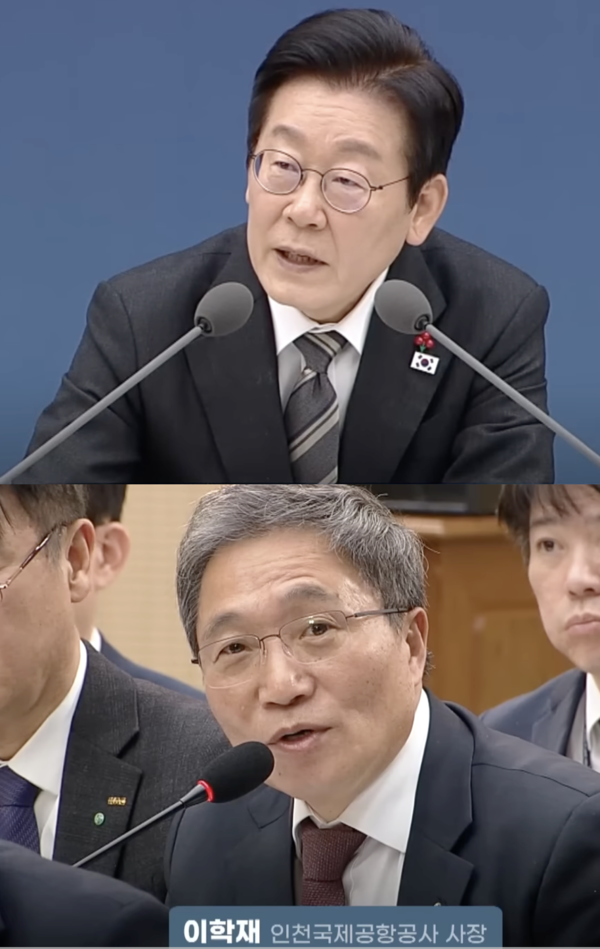
이재명 대통령은 각 부처 산하기관의 업무보고를 받는 자리에서 자신의 얄팍한 지식을 뽐내고자 기관장들에게 불필요하거나 지엽적인 질문을 던지고 면박을 주고 모욕하고 있다. 주로 전 정부에서 임명된 기관장들을 겨눈다.
그중 최악은 12일 국토교통부 업무 보고 자리에서 이학재 인천공항공사 사장에게 던진 질문이다.
이 대통령이 "100달러 지폐를 책갈피에 숨겨 나가는 것을 잘 단속하고 있느냐"고 질문하자, 이학재 사장은 '인천공항공사의 업무는 아니지만 세관과 협조해 나가겠다'는 뉘앙스의 답변을 했다.
그러자 "공항공사 사장이 그것도 모르느냐" "질문의 요지도 제대로 파악 못하느냐" "참 말이 길다, 취임을 언제 했느냐" "3년이나 되었는데도 업무 파악도 못했냐" 등의 말을 쏟아내며 이학재 사장을 몰아붙였다.
제 3자가 봐도 너무한다는 생각이 들 정도니 당사자인 이학재 사장은 얼마나 모욕감을 느껴겠는가?
그런데 이 대통령이 이학재 사장에게 질문한 것은 번지수를 잘못 찾은 것이다. 그 질문은 인천공항공사가 아니라 (인천)세관에 해야 할 내용이다.
엉뚱한 곳에 가서 질문해 놓고 답변을 제대로 못 한다고 되레 역성을 내고 질책한다.
공항에서 미화 1만 달러(또는 이에 상응하는 외화) 이상을 신고 없이 반출, 반입하는 것을 단속하는 것은 전적으로 '세관(관세청)'의 소관 업무이다.
공항공사는 여객 편의 및 공항운영을 담당할 뿐, 외환반출입 단속 권한은 없다.
두 기관의 역할과 업무는 아래와 같이 명확히 구분되어 있다.
1. 세관(관세청)의 소관 업무
국경을 통한 현금·유가증권 반출ᄋ반입 단속, 외환거래법·관세법에 따라 신고 의무 위반자 조사 및 처벌, 출국장/입국장 세관 검사대 운영,
X-ray 검색, 휴대품 검사, 면세범위 확인 등의 전반적 통관 업무이다.
즉, 달러 등 외화 소지액 단속과 처벌은 100% 세관 소관이다.
2. 공항공사(한국공항공사, 인천국제공항공사)의 역할
공항시설 운영(터미널, 활주로, 상업시설 등), 보안검색 협력(보안검색은 경찰청·국토부 산하 보안요원), 여객의 안전·편의 제공이다.
외화 반출입 단속 또는 적발 권한은 전혀 없다.
공항공사는 단속 권한도, 조사·처벌 권한도 없다.
공항에서 외환 신고 위반이 발생하면 전적으로 관세청(세관)의 직무이다.
무식한 이 대통령이 관세청에 질문해야 할 것을 인천공항공사 사장에게 질문하니 이학재 사장도 당황할 수밖에 없고, 차마 대통령의 무지를 지적할 수 없어 '그건 세관 업무이고 소관이니 관세청에 질문하시라'는 말은 못하고 '세관과 협조하겠다'고 답변했는데, 되레 모른다고 면박을 받았다.
이 대통령의 얄팍한 지식 자랑은 인천공항공사 업무보고에서만 있지 않았다.
동북아역사재단 박지향 이사장에게는 '환빠'에 대해 물으면서 공박을 주기도 했다. '환빠'는 환단고기(桓檀古記) 추종자를 말한다.
'환단고기'는 고조선(단군조선) 이전에 환국과 배달국이 존재햇고 그 영역이 시베리아까지 넓었다는 것이다.
이재명 대통령이 이에 관심이 있는지 모르지만, 강단 역사학계에서는 환단고기를 '위서(僞書)'로 보고 있고, 이걸 주장하는 사람들은 '국뽕'에 취한 사이비 역사학자일뿐으로 거리를 두고 있다. 이런 사안을 국민들이 다 보는 국정보고 현장에서 대통령이 거론하는 이유를 모르겠다.
이 대통령은 또 교육부 업무보고를 받는 자리에서 "'대인배'라는 말도 하는데 이 역시 잘못이다. 소인배·시정잡배라는 말에서 알 수 있듯 '배(輩)'는 저잣거리의 건달이나 '쌍놈'을 뜻한다"며 "결국 대인배라는 단어는 '훌륭한 나쁜 놈'이라는 뜻이 된다"고 지적했다.
그렇다면 선배, 후배라는 말도 쓰지 말아야 하나? 똑같이 한자로 같은 '배'를 쓰는데 말이다. 한자의 '배'는 Group이나 Class를 의미하는 것이지 거기에 폄하나 부정적인 뜻은 없다.
어디서 들은 어줍잖은 지식으로 국민들을 가르치려 들고 얄팍한 지식을 자랑하려 하지만, 그것이 자신의 무식과 무지를 드러내고 있다.
어쩌다 윤석열 대통령에 이어 저런 대통령을 맞았는지 우리 국민은 지지리도 복도 없다.
<챗GPT가 작성한 영문기사>
President Lee’s Misplaced Rebuke… Who Actually Has Authority Over Foreign Currency Controls?
By Ryu Jong-ryeol, Political Commentator
During briefings from agencies under various ministries, President Lee Jae-myung has been berating and humiliating agency heads by posing unnecessary or tangential questions—apparently in an attempt to flaunt his shallow knowledge. His targets are primarily agency heads appointed by the previous administration.
The worst example occurred on the 12th, during a policy briefing by the Ministry of Land, Infrastructure and Transport, when President Lee directed a question at Lee Hak-jae, president of Incheon International Airport Corporation.
President Lee asked whether the airport was properly cracking down on people smuggling out $100 bills hidden inside books. Lee Hak-jae replied with the nuance that, while this was not the airport corporation’s responsibility, it would cooperate with Customs.
President Lee then unleashed a barrage of remarks: “Doesn’t the head of the airport corporation even know that?” “Do you not even understand the point of the question?” “You talk too much.” “When did you take office?” “It’s been three years and you still don’t understand your job?”
Even a third-party observer would find this excessive. One can only imagine the level of humiliation felt by Lee Hak-jae himself.
But the problem is that President Lee’s question was fundamentally misdirected. It should have been addressed not to Incheon International Airport Corporation, but to (Incheon) Customs.
He asked the wrong institution, then lashed out for not receiving the answer he wanted.
Cracking down on the undeclared export or import of more than $10,000 (or its equivalent in foreign currency) at airports falls entirely under the jurisdiction of Customs (the Korea Customs Service). The airport corporation is responsible for passenger convenience and airport operations—it has no authority whatsoever over foreign currency controls.
The roles of the two institutions are clearly defined as follows.
1. Responsibilities of Customs (Korea Customs Service)
Customs is responsible for controlling the cross-border movement of cash and securities; investigating and penalizing violations of reporting obligations under the Foreign Exchange Transactions Act and the Customs Act; operating customs inspection counters at departure and arrival halls; conducting X-ray screening, baggage inspections, and duty-free allowance checks—in short, overall customs clearance operations.
Enforcement and punishment related to carrying foreign currency such as U.S. dollars are 100 percent under Customs’ authority.
2. Role of Airport Corporations (Korea Airports Corporation, Incheon International Airport Corporation)
Airport corporations manage airport facilities (terminals, runways, commercial facilities), cooperate in security screening (which is conducted by police and security personnel under the Ministry of Land, Infrastructure and Transport), and ensure passenger safety and convenience.
They have absolutely no authority to regulate or crack down on foreign currency movements, nor do they possess investigative or punitive powers.
If a foreign exchange reporting violation occurs at an airport, it is entirely the responsibility of Customs.
Because President Lee—out of ignorance—directed a question meant for Customs at the president of the airport corporation, Lee Hak-jae had no choice but to appear flustered. Unable to point out the president’s lack of understanding directly, he refrained from saying, “That is a Customs matter; you should ask the Korea Customs Service,” and instead replied diplomatically that he would cooperate with Customs—only to be publicly rebuked for “not knowing.”
President Lee’s shallow displays of knowledge were not limited to the airport briefing.
At another session, he challenged Park Ji-hyang, head of the Northeast Asian History Foundation, by asking about so-called hwanppa—a term referring to followers of Hwandan Gogi.Hwandan Gogi claims that before Gojoseon (Dangun Joseon), there existed the states of Hwanguk and Baedal, whose territory allegedly extended as far as Siberia.
Whether President Lee has a personal interest in this is unclear, but mainstream academic historians regard Hwandan Gogias a fabricated text, and those who promote it are widely viewed as pseudo-historians intoxicated with nationalist fantasy. It is difficult to understand why the president would raise such an issue during a nationally televised government briefing.
President Lee also claimed during a Ministry of Education briefing that the termdaeinbae (literally, “great person”) is incorrect, arguing that because terms likesoinbae (petty person) orsijeong-japbae imply ruffians or lowlifes, the characterbae (輩) refers to street thugs or “base people,” making daeinbaemean a “great bad person.”
If that logic holds, should we also stop using the wordsseonbae (senior) and hubae (junior), which use the same character? In fact, the Chinese characterbaesimply means a group or category—it carries no inherently derogatory or demeaning connotation.
Attempting to lecture the public with half-baked knowledge and to flaunt superficial learning, President Lee instead exposes his own ignorance and lack of understanding.
After President Yoon Suk-yeol, how did the nation end up with another president like this? The Korean people truly seem to be ill-fated.
#번지수잘못 #업무무지 #국정보고논란 #이재명질타 #이재명공항공사사장
#GovernmentAccountability #ForeignCurrencyControls #PresidentialMissteps
관련기사
- 이재명 정권, 추석연휴 인천공항 불법 점거한 노조 편을 들다!
- 李대통령의 '환단고기' 언급에, 이준석 왜 '반지의 제왕' 꺼냈나?
- 공항 출국시 '책' 휴대를 조심할 것!...李대통령의 특별지시
- 모멸을 통치로 착각하는 대통령에게...삼성임원 출신 女정치인의 직격
- 책갈피에 '달러' 끼우는 밀반출 수법...李대통령의 과거 경험담?
- President Lee’s Misplaced Rebuke… Who Actually Has Authority Over Foreign Currency Controls?
- 李대통령에게 창피당한 이학재 사장의 이틀 뒤 '반격'...무슨 내용?
- '실리콘 복대' 두르면 공항 금속탐지기 피할 수 있나?
- 세간에서 왜 이재명을 ‘파란 윤석열’이라 부르나?
- 李대통령, '환단'고기 먹고 체하셨나...40년 언론인의 시선
- [오진영 유쾌통쾌] 이 대통령의 찌질한 '뒷끝'?
- '넷플릭스보다 재밌는 업무보고' 생중계 흥행…그런데 이재명 지지율?