

If a foreign exchange reporting violation occurs at an airport, it is entirely the responsibility of Customs
[Choice Times=Ryu Jong-Ryeol, Political Commentator]
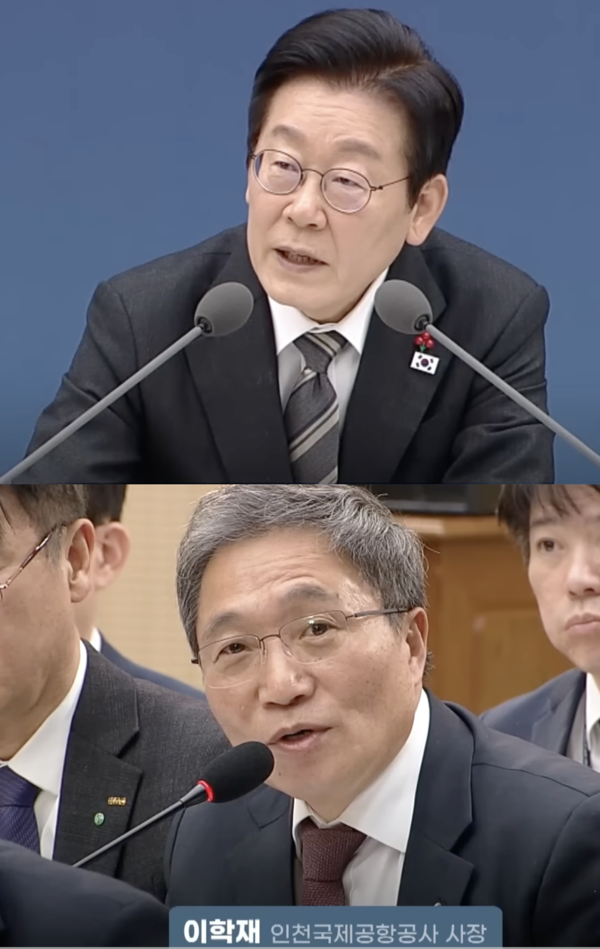
During briefings from agencies under various ministries, President Lee Jae-myung has been berating and humiliating agency heads by posing unnecessary or tangential questions—apparently in an attempt to flaunt his shallow knowledge. His targets are primarily agency heads appointed by the previous administration.
The worst example occurred on the 12th, during a policy briefing by the Ministry of Land, Infrastructure and Transport, when President Lee directed a question at Lee Hak-jae, president of Incheon International Airport Corporation.
President Lee asked whether the airport was properly cracking down on people smuggling out $100 bills hidden inside books. Lee Hak-jae replied with the nuance that, while this was not the airport corporation’s responsibility, it would cooperate with Customs.
President Lee then unleashed a barrage of remarks: “Doesn’t the head of the airport corporation even know that?” “Do you not even understand the point of the question?” “You talk too much.” “When did you take office?” “It’s been three years and you still don’t understand your job?”
Even a third-party observer would find this excessive. One can only imagine the level of humiliation felt by Lee Hak-jae himself.
But the problem is that President Lee’s question was fundamentally misdirected. It should have been addressed not to Incheon International Airport Corporation, but to (Incheon) Customs.
He asked the wrong institution, then lashed out for not receiving the answer he wanted.
Cracking down on the undeclared export or import of more than $10,000 (or its equivalent in foreign currency) at airports falls entirely under the jurisdiction of Customs (the Korea Customs Service). The airport corporation is responsible for passenger convenience and airport operations—it has no authority whatsoever over foreign currency controls.
The roles of the two institutions are clearly defined as follows.
1. Responsibilities of Customs (Korea Customs Service)
Customs is responsible for controlling the cross-border movement of cash and securities; investigating and penalizing violations of reporting obligations under the Foreign Exchange Transactions Act and the Customs Act; operating customs inspection counters at departure and arrival halls; conducting X-ray screening, baggage inspections, and duty-free allowance checks—in short, overall customs clearance operations.
Enforcement and punishment related to carrying foreign currency such as U.S. dollars are 100 percent under Customs’ authority.
2. Role of Airport Corporations (Korea Airports Corporation, Incheon International Airport Corporation)
Airport corporations manage airport facilities (terminals, runways, commercial facilities), cooperate in security screening (which is conducted by police and security personnel under the Ministry of Land, Infrastructure and Transport), and ensure passenger safety and convenience.
They have absolutely no authority to regulate or crack down on foreign currency movements, nor do they possess investigative or punitive powers.
If a foreign exchange reporting violation occurs at an airport, it is entirely the responsibility of Customs.
Because President Lee—out of ignorance—directed a question meant for Customs at the president of the airport corporation, Lee Hak-jae had no choice but to appear flustered. Unable to point out the president’s lack of understanding directly, he refrained from saying, “That is a Customs matter; you should ask the Korea Customs Service,” and instead replied diplomatically that he would cooperate with Customs—only to be publicly rebuked for “not knowing.”
President Lee’s shallow displays of knowledge were not limited to the airport briefing.
At another session, he challenged Park Ji-hyang, head of the Northeast Asian History Foundation, by asking about so-called hwanppa—a term referring to followers of Hwandan Gogi. Hwandan Gogi claims that before Gojoseon (Dangun Joseon), there existed the states of Hwanguk and Baedal, whose territory allegedly extended as far as Siberia.
Whether President Lee has a personal interest in this is unclear, but mainstream academic historians regard Hwandan Gogias a fabricated text, and those who promote it are widely viewed as pseudo-historians intoxicated with nationalist fantasy. It is difficult to understand why the president would raise such an issue during a nationally televised government briefing.
President Lee also claimed during a Ministry of Education briefing that the term daeinbae (literally, “great person”) is incorrect, arguing that because terms likesoinbae (petty person) orsijeong-japbae imply ruffians or lowlifes, the characterbae (輩) refers to street thugs or “base people,” making daeinbaemean a “great bad person.”
If that logic holds, should we also stop using the words seonbae (senior) and hubae (junior), which use the same character? In fact, the Chinese characterbaesimply means a group or category—it carries no inherently derogatory or demeaning connotation.
Attempting to lecture the public with half-baked knowledge and to flaunt superficial learning, President Lee instead exposes his own ignorance and lack of understanding.
After President Yoon Suk-yeol, how did the nation end up with another president like this? The Korean people truly seem to be ill-fated.
#GovernmentAccountability #ForeignCurrencyControls #PresidentialMissteps