

북한 언론매체들은 김주애를 ‘존경하는 자제분’이라는 호칭을 달아 특별한 인물로 예우
[최보식의언론=장성민 국민의힘 안산시갑 당협위원장(전 대통령실 미래전략기획관)]
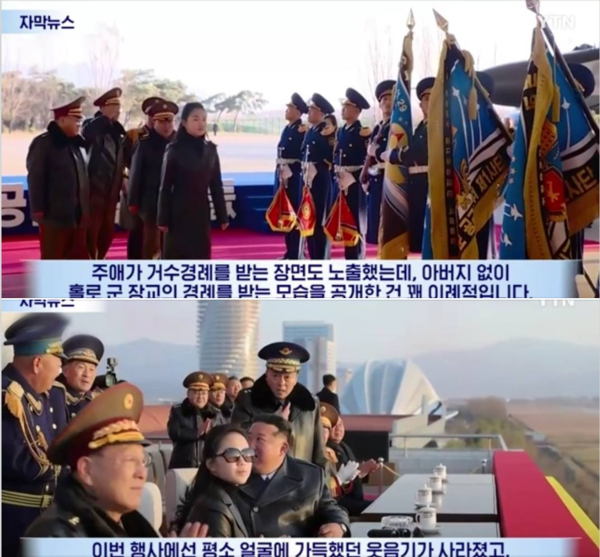
북한 노동신문은 지난달 28일 북한 공군 창설 80주년 기념행사가 제2공군사단 59길영조영웅연대 갈마비행장에서 진행됐다고 밝혔다.
김정은 위원장은 딸 주애를 대동했고, 이후 조선중앙TV를 통해 아버지 없이 홀로 장교들로부터 경례를 받는 주애의 모습이 전파를 탔다. (편집자)
김주애가 등장했다. 김주애가 지난 11월 28일 북한 공군 창설 80주년 기념식에 김정은과 함께 검은 가죽 코트를 입고 등장했다.
북한 언론매체들은 김주애를 ‘존경하는 자제분’이라는 호칭을 달아 특별한 인물로 예우했다. 김주애의 등장은 지난 9월 김정은이 중국 전승절 기념식 때 대동한 지 3개월 만이다.
김정은이 중국 전승절 참관을 위해 방중했을 때 김주애를 대동한 것을 놓고 많은 외교관들은 김정은이 자신의 후계자임을 알리기 위한 외교적 포석이라는 분석을 내놨다.
중국 전승절 참관 행보에 김주애를 동행시킨 김정은은 당시 두 가지 목적을 가졌던 것으로 보인다.
하나는 순망치한의 관계에 놓여 있는 북ㆍ중 관계를 고려해 김주애가 사실상 자신의 후계자임을 중국 측에 알리기 위한 후계 포석 차원이었고, 다른 하나는 세계의 이목이 중국 전승절에 맞춰진 기회를 활용해 김주애를 전 세계에 알리기 위한 목적이었다는 분석이다.
김정은은 이 두 가지 목적을 충분히 달성했던 것으로 보인다. 그래서였는지 북한 공군 창설 80주년 행사에 참석한 김주애의 모습은 한층 달라 보였다. 그의 행보는 매우 독자적이고 독립적인 측면이 강해 보였으며, 과거 김정은의 뒷꽁무니를 따라다니던 수행원의 모습과는 분명히 달라진 행보를 보였다.
공군 고위 장성들은 김정은에게 인사를 한 뒤 김주애를 향해서도 별도의 거수경례로 인사했다. 김정은이 의장대 행렬을 마치면 그 뒤에 독자적으로 김주애가 걸어와 공군기에 목례로 인사하는 장면, 김정은이 공군 파일럿들을 격려한 뒤 일정한 거리를 유지한 채 김주애가 걸어와 독립적으로 인사를 나누는 장면은 매우 특이해 보인다.
이러한 김주애의 독자적, 독립적 행보는 기존에 볼 수 없었던 낯선 장면이다. 때로는 김정은의 수행원보다 김주애의 수행원이 더 많아 보이는 장면도 연출된다. 추종하는 세력이 김정은보다 김주애 쪽에 더 많아 보이는 세(勢) 확산의 느낌까지 준다.
김주애의 행보는 매우 여유로워 보였다. 특히 행사 중간에 공군 파일럿, 북한 고위 간부들과 함께 공연을 관람하며 즐기는 모습도 인상적이었다. 북한의 백두혈통이라는 김여정은 구석진 곳에 앉아 있었고, 김주애는 김정은과 함께 정중앙에 배치된 의자에 앉아 ‘권력 정중앙인 김정은’의 곁으로 바짝 다가간 모습이었다. 김주애로의 후계 구도가 매우 빠르게 진행되고 있다는 느낌이다.
북한은 왜 김주애의 후계 구도를 서두르는 것일까? 1983년 1월 8일생으로 2026년 1월 8일이 되면 만 42세에 불과한 김정은을 놔두고, 왜 불과 13세로 추정되는 어린 김주애로의 후계 작업을 서두르는 것일까?
여기에는 몇 가지 이유가 있다.
첫째, 북한의 급격한 세대교체다. 북한에도 거대한 인구 변화가 시작됐다. 6.25 전쟁을 겪은 고령 세대가 퇴장하고 MZ세대와 더불어 알파세대가 등장하면서, 강요된 주체사상과 6.25 전쟁을 통한 대남 적대감, 전쟁의 호전성, 강압 체제에 대한 충성도가 현격히 떨어져 신세대들의 지지를 통한 체제 유지가 절박해졌다. 그래서 신세대들에게 어필할 수 있는 신세대 지도자를 조기에 등장시켜 내세우는 것이 불가피해졌다.
이것이 어린 김주애의 조기 후계 구도 작업을 서두르는 이유 중 하나다. 이는 김일성, 김정일식 냉전 주체사상의 강요를 통한 억압적 체제 유지 방식이 북한의 신세대들에게 더 이상 어필하지 않는다는 점을 반증한다. 억압식 통치는 젊은 군인들에게조차 체제 저항과 체제 반발을 일으키고 있다는 대북 정보도 있다.
둘째, 김정은의 체제를 지금보다 한 단계 격상시키기 위해 '중국식 모델'을 수용하고 있다는 분석이다. 중국이 시진핑 총서기를 주석직에 위치시키고 실무 행정은 리창 총리에게 전담케 한 것처럼, 북한 역시 김정은을 주석직으로 올리는 중국식 시진핑 통치 체제를 따라가고 있다는 분석이다.
셋째, 북한의 권력 이동기 경험이다. 김일성은 조기에 김정일을 후계 체제로 내세워 권력 이양을 안정적으로 이뤘지만, 김정일은 후계 구도 작업을 조기에 완결짓지 못해 김정은으로의 권력 이양 과정에서 많은 우여곡절을 겪었다. 특히 고모부 장성택의 수렴 정치와 숙청 과정에서 내부 정치적 불안정이 컸던 경험이 있다. 이 경험을 토대로 만일의 상황에 대비해 김정은의 후계 작업도 조기에 가시화해야 한다는 체제 수호자들의 판단이 김주애의 후계 등장을 서두르게 하고 있다.
넷째, 북한의 핵무력 완성, 핵 보유의 헌법 명시, 두 개의 적대국가론 등을 통해 외부의 영향을 철저히 차단한 후, 내부 체제 단속에 전념하면서 기존의 혐오국가, 선군정치, 강성독재의 이미지를 탈피하려는 전략이다. 새로운 신세대 국가, 매력 국가를 지향하는 탈선군정치, 탈강성 독재국가 전략을 통해 한국의 젊은 세대들에게 어필하려는 ‘신세대 대남 전략’과도 무관치 않다. 한국의 BTS, 블랙핑크, 뉴진스로 대표되는 한류의 세계화에 맞춰 북한 역시 세계 신세대에 어필할 ‘신세대 리더십’ 구축을 서두르고 있다. 세계 젊은 감성 세대들의 시선을 북한으로 돌려보겠다는 관심 전략이다.
갈수록 김주애의 등장은 더욱 많아질 것이고, 김정은은 수령, 주석, 상왕의 체제로 한 단계 위로 올라서며 시진핑을 마오쩌둥의 위치로 끌어올린 중국처럼 자신의 지위 또한 김일성의 그것으로 상향시키는 권력 이동 작업을 진행시켜 나가고 있다.
이재명 정권이 내란몰이에 빠져 국가 체제 전반이 붕괴되고 있는 반면, 우리의 적국인 북한은 국가 체제 강화를 위한 선제적 작업을 만방으로 준비하고 있다. 이재명식 내란몰이 정치가 대한민국의 법치와 자유민주주의 체제를 내부로부터 흔들고 있는 동안, 적국의 국가 체제는 더욱 강화되고 있다. 북한은 어린 김주애의 후계 체제를 조기에 구축해 미래에 닥칠 정치 혼란과 체제 불안을 제거하려는 국가 미래전략에 혈안이 되어 있다. 그러나 이재명은 내란몰이 정치에 빠져 정치 혼란과 체제 불안을 가속화시키고 있다.
김주애의 행보에 더 큰 관심을 가져야 할 시간이다. 북한은 이미 미래를 준비하고 있다.
<챗GPT가 작성한 영문기사>
Kim Jong Un’s Daughter Ju-ae Receives Separate Salutes from North Korean Troops… Something Unusual Is Unfolding?
By Jang Sung-min, Chair of the People Power Party Ansan Gap Chapter
(Former Senior Secretary for Future Strategy Planning, Presidential Office)
North Korea’s Workers’ Party newspaper Rodong Sinmun reported last month that a ceremony marking the 80th anniversary of the founding of the North Korean Air Force was held on November 28 at Galma Airfield, home to the 59th Gil Yong-jo Hero Regiment of the Second Air Force Division.
Chairman Kim Jong Un attended the event accompanied by his daughter, Ju-ae. Later, Korean Central Television broadcast footage showing Ju-ae receiving salutes from officers on her own, without her father present. (Editor’s note)
Kim Ju-ae made another public appearance. On November 28, she appeared alongside Kim Jong Un at the 80th anniversary ceremony of the North Korean Air Force, wearing a black leather coat. North Korean state media treated her as a special figure, referring to her with the honorific title “the respected daughter.”
Her appearance came just three months after Kim Jong Un accompanied her to China’s Victory Day commemoration in September. Many diplomats interpreted Kim’s decision to bring Ju-ae to the event in China as a diplomatic signal intended to indicate that she is his chosen successor.
When Kim Jong Un traveled to China to attend the Victory Day ceremony with Ju-ae, he appeared to have had two objectives. One was to signal to China—given the North Korea–China relationship often described as “lips and teeth” (inseparable allies)—that Ju-ae is effectively his successor. The other was to use the occasion, when global attention was focused on China’s Victory Day, to introduce Ju-ae to the world.
Kim Jong Un appears to have achieved both objectives. Perhaps for that reason, Ju-ae’s appearance at the Air Force’s 80th anniversary ceremony looked markedly different. Her movements appeared far more autonomous and independent, clearly distinct from the image of a mere attendant trailing behind Kim Jong Un, as seen in the past.
After saluting Kim Jong Un, senior Air Force generals also rendered separate hand salutes to Ju-ae. Scenes in which Ju-ae followed independently after Kim Jong Un completed an honor guard review and bowed to the Air Force flag, as well as scenes where Kim encouraged Air Force pilots and Ju-ae followed at a measured distance to exchange greetings on her own, appeared highly unusual.
This independent and autonomous conduct by Ju-ae is unprecedented and unfamiliar. At times, there even appeared to be more aides surrounding Ju-ae than Kim Jong Un. The scenes conveyed an impression that the number of followers gravitating toward Ju-ae may even exceed those around Kim, suggesting an expansion of her power base.
Ju-ae’s demeanor appeared relaxed and confident. Particularly striking were scenes in which she watched performances with Air Force pilots and senior North Korean officials, seemingly enjoying herself. Kim Yo-jong, a member of the so-called “Baekdu bloodline,” was seated in a relatively marginal position, while Ju-ae sat with Kim Jong Un in the very center, close beside him—at the very heart of power. This gave the strong impression that the succession structure centered on Ju-ae is advancing at a rapid pace.
Why, then, is North Korea rushing to establish Ju-ae as the successor? Why push ahead with succession preparations for a child estimated to be only about 13 years old, when Kim Jong Un, born on January 8, 1983, will be just 42 years old as of January 8, 2026?
There are several possible reasons.
First, North Korea is undergoing rapid generational change. A major demographic shift has begun, with the elderly generation that experienced the Korean War exiting the stage and the MZ generation and Alpha generation emerging. As a result, loyalty to forcibly imposed Juche ideology, hostility toward South Korea rooted in the Korean War, militaristic aggressiveness, and allegiance to a coercive system have all sharply declined. The regime has become desperate to secure support from younger generations in order to maintain the system. This makes it inevitable to promote a leader who can appeal to the new generation at an early stage.
This is one reason for accelerating the early succession process centered on the young Kim Ju-ae. It also demonstrates that the Cold War–style Juche indoctrination and repression employed under Kim Il Sung and Kim Jong Il no longer resonate with North Korea’s younger generations. There are even intelligence reports suggesting that oppressive rule is provoking resistance and backlash against the system among young soldiers.
Second, analysts suggest that Kim Jong Un is adopting a “Chinese-style model” to elevate his regime to a higher level. Just as China positioned Xi Jinping as president while entrusting day-to-day administration to Premier Li Qiang, North Korea may be following a similar model—raising Kim Jong Un to a presidential or chairman-level role akin to Xi’s governing structure.
Third, North Korea’s past experience with power transitions is a factor. Kim Il Sung established Kim Jong Il early as his successor and managed a relatively stable transfer of power. Kim Jong Il, however, failed to finalize a succession plan early, leading to significant turbulence during the transition to Kim Jong Un, including severe internal instability amid the regency and purge of Jang Song-thaek. Learning from this experience, regime guardians may believe it is necessary to make Kim Jong Un’s own succession plan visible at an early stage, thereby accelerating Ju-ae’s emergence.
Fourth, after completing its nuclear force, enshrining nuclear weapons in the constitution, and advancing the “two hostile states” doctrine to thoroughly block external influence, North Korea is focusing on internal discipline while seeking to shed its image as a pariah state defined by “military-first politics” and hardline dictatorship. This strategy—aimed at presenting itself as a new, attractive, next-generation state—also aligns with a “new-generation South Korea strategy” designed to appeal to young people in South Korea. In step with the globalization of Korean pop culture represented by BTS, Blackpink, and NewJeans, North Korea appears eager to construct a form of “next-generation leadership” that can appeal to younger audiences worldwide, drawing the attention of global youth sensibilities toward North Korea.
Ju-ae’s appearances are likely to increase further. Kim Jong Un, meanwhile, appears to be elevating himself to a higher tier—ruler, chairman, and kingmaker—much as China elevated Xi Jinping toward a Mao Zedong–like position, thereby moving his own status closer to that once held by Kim Il Sung.
While the Lee Jae-myung administration is, in the author’s view, mired in accusations of “manufactured insurrection,” leading to the erosion of the overall state system, North Korea—South Korea’s adversary—is preparing far-reaching, preemptive measures to strengthen its state structure. As Lee Jae-myung–style politics, characterized by insurrection rhetoric, undermines South Korea’s rule of law and liberal democratic system from within, the enemy state’s system is becoming ever more consolidated.
North Korea is obsessed with a future-oriented national strategy aimed at eliminating potential political turmoil and systemic instability by establishing Ju-ae’s succession structure at an early stage. By contrast, Lee Jae-myung’s politics, the author argues, are accelerating political chaos and systemic instability.
It is time to pay closer attention to Kim Ju-ae’s movements. North Korea is already preparing for the future.
#통일교논란 #사법거래의혹 #권력과면죄
#NorthKoreaSuccession #KimJuae #KimJongUn
관련기사
- 우원식과 김정은 "7년 만에 다시 봅니다" "네"...이게 톱뉴스인가?
- '12살 김주애'의 중국 신고식에서 가장 놀라운 점은?
- 文 정부 시절 ‘훈련 힘들게 시킨다’고 군단장 해임 청원 사태도
- 김주애 ‘사랑하는 딸’에서 ‘존경받는 딸’로...BBC의 분석
- Kim Jong Un’s Daughter Ju-ae Receives Separate Salutes from North Korean Troops… Something Unusual Is Unfolding?
- 한결 더 위험해진 김정은!...英 유력주간지 이코노미스트 보도
- 북한을 지배할 지도 모르는 10대 소녀? ... 英이코노미스트
- 또 터져나온 "13세 김주애 후계자설'...그 숨겨진 배경에는
- 평양에 집결된 군인들?... '김주애 후계자설'에 가려진 진실
- '아이돌'은 바뀌는데 ... '정계·방송계 나그네들'은 왜 고인물인가