

A word of advice: pay a bit more attention to tariff issues with the United States
[Choice Times=Joo-Hyun Park, CEO of Jaedam Entertainment]
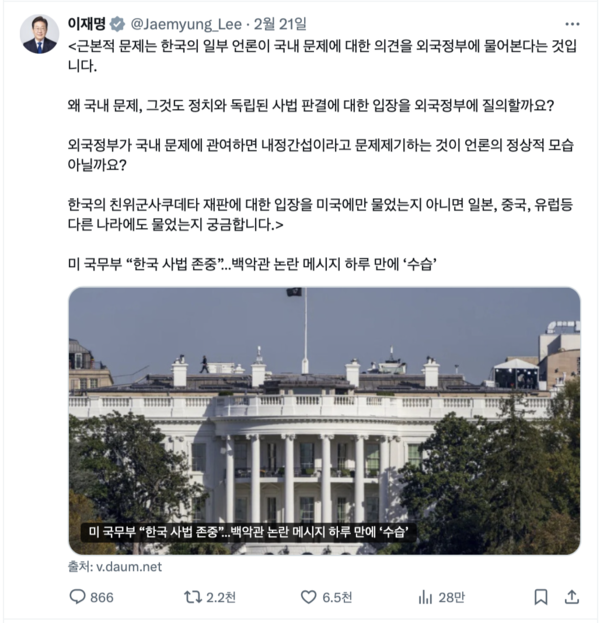
On the 20th, a spokesperson for the U.S. State Department responded to a question from a South Korean reporter about the first-instance verdict sentencing former president Yoon Suk Yeol to life imprisonment by saying, “The United States and South Korea share a commitment to the rule of law,” adding that “this is a matter for South Korea’s judicial system, and the United States respects the independence of democratic institutions.”
Immediately afterward, President Lee Jae-myung shared on X (formerly Twitter) a Hankyoreh article titled “U.S. State Department: ‘Respect for Korean judiciary’… White House ‘cleanup’ message a day after controversy” and publicly rebuked the reporter who had asked the question.
President Lee said, “The fundamental problem is that some Korean media ask foreign governments for opinions on domestic issues,” and added, “Why ask a foreign government about a domestic matter—especially a judicial ruling that is independent of politics?” He went on to say, “If a foreign government involves itself in domestic affairs, shouldn’t the media be the first to raise the issue of interference in internal affairs?” He then asked whether the reporter had posed the same question not only to the United States but also to Japan, China, Europe, and other countries. (Editor’s note)
You would think the United States had crossed some sort of red line.
This time, the president’s smartphone spewed fire at the domestic press. He effectively put a target on a Korean journalist who had asked, in the White House briefing room, about the life-sentence verdict for former president Yoon, branding it “servility that invites foreign interference.”
A Washington correspondent asking an ally’s government how it views the trial of a former head of state is not “servility”; it is simply doing one’s job. The White House itself drew a perfectly reasonable line, saying, “It is a decision of the Korean judiciary, so we have no comment.” Why, then, did the president suddenly hit the panic button and start shouting about “interference in internal affairs”?
The real reason seems to lie in the spokesperson’s very next sentence.
While drawing a line on the verdict itself, the White House added, “However, we are concerned that the Korean government is politically targeting American companies (Coupang) and religious groups.”
In other words, the Trump administration was saying, “Your domestic squabbles are your business, but don’t touch our people,” delivering a precise and heavy blow straight to the current administration’s solar plexus.
To prevent that blunt warning from making front-page headlines, the president stepped in personally and set off a smokescreen, attacking “servile media.” With his diplomatic missteps about to be exposed, he opted for the classic tactic of shooting the messenger to bury the message.
In a country where anyone who doesn’t know Coupang might as well be a spy, the president may have felt a fleeting sense of satisfaction cracking jokes like “Coo-what?” and handing out rhetorical shots of soda. But with a U.S. congressional hearing looming on the 23rd, where that very name is inconveniently etched into the record, his mood is likely far from calm. He told people to “go take on Coupang,” then, finding the opponent less than easy, chose instead to slap around a reporter who seemed like an easier target—hardly anything but cheap.
The Lee Jae-myung administration’s “sovereignty defense” sensor operates in a strikingly mechanical and selective way. When Kim Yo-jong of North Korea issued overt “orders” and raged about South Korean drones flying north, even the unconnected unification minister rushed out to bow deeply and apologize. Faced with a real violator of sovereignty, they practically opened the front door themselves. Yet when an ally merely points out facts—“Don’t interfere with our companies’ business”—they suddenly channel Admiral Yi Sun-sin and start bellowing.
The president seems deeply irritated by the public’s nickname for him, “keyboard warrior Lü Bu.” A word of advice: pay a bit more attention to tariff issues with the United States—the very power that even Europe and Japan treat with extreme caution—and perhaps a bit less to real estate, sanitary pads, and school uniforms. You might feel a little less “triggered” that way.
#PressFreedom #DiplomaticTensions #RuleOfLaw