

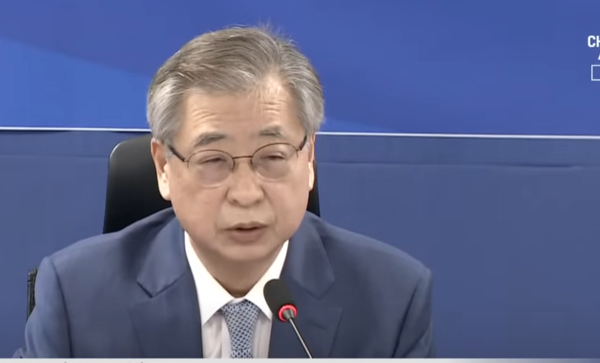
Seo Hoon testified, “There is no situation in which God does not intervene,”
[Choice Times=Ji-Hyun Park, Senior Fellow, Center for Asia Pacific Strategy (CAPS), U.K.-based North Korean defector]
Is this what “praising God” in church looks like?
In September 2020, a citizen of the Republic of Korea was killed at sea by North Korean soldiers without being rescued, and his body was burned. His name was Lee Dae-jun, a Ministry of Oceans and Fisheries official and the father of two children. He was reduced from a person to be rescued into a “target to be handled,” and his final plea was, “Please save me.”
Five years later, in January 2026, Seo Hoon, the former National Security Office chief who condoned—no, abetted—that killing, stood to pray and lecture at a unification vision camp. (On the 13th, at Ark Church in Bangbae-dong, Seoul, former NSO chief Seo Hoon delivered a 40-minute talk titled “We Are New Korea”—Editor’s note.)
Seo Hoon testified, “There is no situation in which God does not intervene,” and shared prayers for unification with the audience. Yet about the very case in which he was acquitted—the death of Lee Dae-jun—he said not a single word.
The Seoul Central District Court’s Criminal Division 25 acquitted Seo Hoon and four other senior officials from the Moon Jae-in administration who bore responsibility for the Lee Dae-jun case.
However, the 700-page verdict released by the bereaved family meticulously records the North Korean military’s organized and brutal orders to kill:
-
“Apply fuel (condensed oil) and handle it cleanly.” — Order to incinerate the body
-
“They’re saying to do it quickly with 7.62mm.” — Order to execute by machine gun
-
“They’re saying to erase it completely.” — Order to eliminate all traces
Civil servant Lee Dae-jun was dragged by rope and interrogated by North Korean soldiers wearing gas masks. His pleas for rescue were ignored. He was ultimately shot to death with a machine gun, and his body was burned. This was not a mere military response; it was an unmistakable crime against humanity.
Yet Seo Hoon—one of those responsible and then head of the National Security Office—declared at the “U-Korea Unification Vision Camp” that “God intervenes in all situations.”
Seo Hoon enrolled in a seminary and recalled his experiences in North Korea, saying he “prayed over the reality of North Korea.” He spoke of establishing a church at the Sinpo nuclear power plant site, decorating a Christmas tree, and holding worship services.
But on the very land where he prayed, the regime he called a “partner for reconciliation” executed and burned a citizen of the Republic of Korea.
And the government to which he belonged stood by for six hours without issuing rescue orders, branding that death as “voluntary defection.” What meaning can his talk of “God’s intervention” possibly have in the face of that death?
Seo Hoon said, “God enables us to get through every situation.” But Lee Dae-jun did not get through that situation. He was not rescued; he was burned. No one prayed for him. Instead, those who labeled him a “defector” now stand on church pulpits speaking of unification.
This contradiction is not merely the problem of one individual.
It exposes how Korean society selectively handles “sovereignty” and “human rights,” and the hypocrisy of a faith that separates “prayer” from “responsibility.”
It lays bare a double standard: speaking of North Korean human rights while remaining silent before the death of a South Korean citizen killed by North Korea—and covering that silence with prayer. It shows, unvarnished, the face of Korean Christianity.
What is especially infuriating is that defectors were present at that gathering as well. As they listened to Seo Hoon’s lecture about “God,” what, one wonders, did they ask him?
#WestSeaIncident #HumanRightsAndAccountability #FaithAndResponsibility