

한국의 ‘진짜 국가부채’는 GDP 70%를 넘본다
[최보식의언론=박수영 국민의힘 의원]
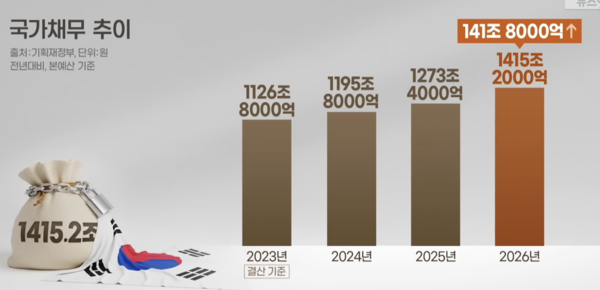
11일 발표된 기재부의 통계를 보면, 지난해 우리나라 일반정부 부채(D2)가 1270조 원(+53.5조 원, GDP 대비 49.7%), 공공부문 부채(D3)는 무려 1738조 원(+63.5조 원, GDP 대비 68%)에 달한다.
일반정부 부채(D2)는 중앙정부와 지방정부의 부채를 더한 국가채무(D1)에서 비영리공공기관 부채를 더한 수치다. IMF, OECD 등 국제기준으로 쓰인다.
공공부문 부채(D3)는 D2에서 비금융 공기업 부채를 더한 수치다. 한국전력 등 공기업 부채가 심각한 우리나라 현실을 가장 적나라하게 드러내는 '진짜 나랏빚'인 셈이다. 공공부문 부채를 기준으로 우리나라 1인당 부채는 3,365만 원이나 된다.
그나마 윤석열 정부의 건전재정으로 23년에 비해 D2 부채비율은 0.8%p, D3 부채비율은 1.5%p 낮아졌다.
하지만 문제는 올해부터다. 이재명 정부는 전임 정부의 재정건전성 기준을 없애고 현금 살포 등 재정 폭주를 멈추지 않고 있다. 이미 내년 D1 국가채무만 1415조 원(GDP 대비 51.6%)이 넘을 전망이다. 여기에 공공기관과 공기업 부채가 더해지면 GDP 대비 70%가 넘는 막대한 나랏빚이 쌓일 가능성이 매우 높다.
하지만 이재명 정부는 그나마 수치가 적어 보이는 D1만 앞세우며 국민 눈속임에 열을 올린다. 국제기준인 D2는 물론, D3도 무시하고, 군인과 공무원 연금 충당 부채까지 더하는 D4(광의의 국가부채)는 공식 통계로 발표조차 하지 않는다.
손바닥으로 하늘을 가릴 수 없다. 이재명 정부는 진짜 우리나라 나랏빚 수준이 얼마인지, 얼마나 미래세대에게 부담이 될지 낱낱이 밝히고, 이제라도 재정건전성을 지켜 나가라.
폭망 경제 정책을 포퓰리즘으로 덮는 이재명 정부 탓에 대한민국이 베네수엘라 수준으로 떨어지고 있다.
<챗GPT가 작성한 영문기사>
Is the Lee Jae-Myung Government “Window-Dressing” the National Debt Figures?
By Soo-Young Park, National Assembly Member (People Power Party)
According to statistics released by the Ministry of Economy and Finance on the 11th, South Korea’s general government debt (D2) reached 1,270 trillion won last year—an increase of 53.5 trillion won, equivalent to 49.7% of GDP.Public sector debt (D3) surged to 1,738 trillion won, up 63.5 trillion won, amounting to 68% of GDP.
General government debt (D2) is calculated by adding the debt of non-profit public institutions to national debt (D1), which consists of central and local government liabilities. This is the standard used by international organizations such as the IMF and OECD.
Public sector debt (D3) adds the liabilities of non-financial public enterprises to D2. It is, in effect, the “real national debt” that most starkly reveals South Korea’s fiscal reality, given the severe indebtedness of state-owned enterprises such as Korea Electric Power Corporation. Based on public sector debt, per-capita debt in South Korea amounts to 33.65 million won.
Thanks to the fiscally disciplined policies of the Yoon Suk-yeol administration, the D2 debt-to-GDP ratio fell by 0.8 percentage points, and the D3 ratio declined by1.5 percentage points compared to 2023.
The real problem, however, begins this year. The Lee Jae-myung government has scrapped the previous administration’s fiscal discipline standards and continues unchecked fiscal expansion, including large-scale cash handouts. As early as next year, D1 national debt alone is projected to exceed 1,415 trillion won, or 51.6% of GDP. When the debts of public institutions and state-owned enterprises are added, total national debt could easily surpass 70% of GDP.
Despite this, the Lee administration emphasizes only D1, which appears numerically smaller, in what amounts to an attempt to mislead the public. It ignores not only the internationally recognized D2, but also D3, and does not even officially publish D4 (broad national debt), which includes pension liabilities for soldiers and civil servants.
One cannot cover the sky with the palm of a hand. The Lee Jae-myung government must fully disclose the true level of South Korea’s national debt, clarify how heavily it will burden future generations, and restore fiscal discipline without delay.
Because the Lee government masks its failed economic policies with populism, South Korea is sliding toward a Venezuela-like situation.
#국가부채위기 #재정건전성붕괴 #이재명정부비판
#NationalDebt #FiscalTransparency #PublicFinance