

What the president displays during state affairs briefings fits squarely into that genre
[Choice Times=Joo-hyun Park, CEO of Jaedam Entertainment]
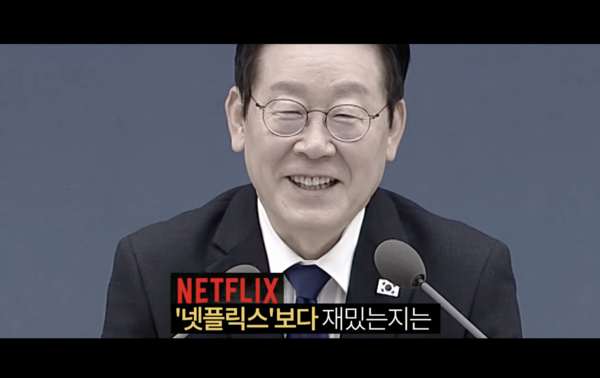
President Lee Jae-myung said of the live broadcast of government affairs briefings, “It’s more entertaining than Netflix.” That was likely no empty remark.
Look at the content dominating Netflix’s rankings. Drug lords, gangsters, dictators, or villains who place themselves above the law—so-called picaresque narratives, where antiheroes take center stage, are everywhere.
What the president displays during state affairs briefings fits squarely into that genre. From the protagonist’s point of view, how could it not be gripping?
The mise-en-scène on screen is straight out of a noir film. The “boss” sits at the head of the table, scowling and barking orders. He tightens discipline by declaring that “administration is about top-down command,” and humiliates subordinates he dislikes by calling them “thieves” in front of the entire nation.
Elite bureaucrats, like rank-and-file organization members, keep their heads down, frantically taking notes. There is no rebuttal, no debate—only the boss’s instructions and absolute obedience. The familiar clichés of worlds ruled by gangsters or dictators, long consumed on Netflix, are broadcast live as reality.
Yet this scene resembles an even more familiar program—one seen not in films, but in North Korean state news: Kim Jong-un’s so-called on-the-spot guidance.
In North Korean broadcasts, the “Supreme Leader” knows everything. At a fish farm, he lectures on feed mixtures; at a machinery factory, he corrects the placement of parts. Scholars who have studied those fields their entire lives desperately jot down his words. The scene unfolding in Seoul’s cabinet meeting room in 2025 is not all that different.
There are no experts—only a powerful strongman issuing solutions as if he were a universal genius.
“Research the Hwandan Gogi,” “Include hair-loss medication in national health insurance”—even when such non-expert directives are issued, questioning them risks being branded a “traitor” and purged.
With a single off-the-cuff remark from the president, decades-old policies and personnel systems of the Republic of Korea are thrown into motion. It mirrors black comedies in which a dictator unrolls a map, issues absurd operational orders, and trembling generals obediently comply.
More than 70 years after the peninsula was divided, it is hard not to laugh bitterly at how similar the styles of power remain. Perhaps we really are “one people” after all. The gene that demands shutting one’s eyes and ears and personally micromanaging everything once power is grasped seems to flow identically in both North and South.
No wonder the president finds it “entertaining.” Films at least have scripts; this is scriptless reality. The dopamine rush of wielding absolute power—watching the national system move in lockstep (or spiral into chaos) at a single word—surely surpasses anything Netflix can offer. In this massive set where he is writer, director, and lead actor, he appears fully immersed in the role of an “absolute ruler.”
The problem is a misunderstanding of genre. The president may believe he is filming a heroic tale with himself as the fixer, but the public is watching a disaster movie. When an unqualified authority figure jerks the steering wheel on a whim, history has already spoiled for us where the bus is likely to crash.
I will not offer the trite admonition that “a president should listen.” He would not listen anyway. One thing, however, is certain: the endings of Netflix gangsters and dictators are rarely good. That is the rule of the genre.
If Netflix becomes boring, viewers can cancel their subscriptions. But this dangerous “real-life noir,” starring the president, is mandatory viewing for the public—and the audience must even pay enormous production costs. It is a reality show far too risky to enjoy with popcorn.
#RealLifeNoir #PowerAndObedience #PoliticsAsRealityTV