

“Freedom of the press does not mean privilege for the press.”
[Choice Times=Seollae Kim, Staff Reporter]
After the SBS branch of the National Union of Media Workers issued a statement titled “Monitoring Power Is Not Terrorism. Stop Attempting to Control the Press,” criticizing President Lee Jae-myung for pressuring an apology, the president responded the very next day.
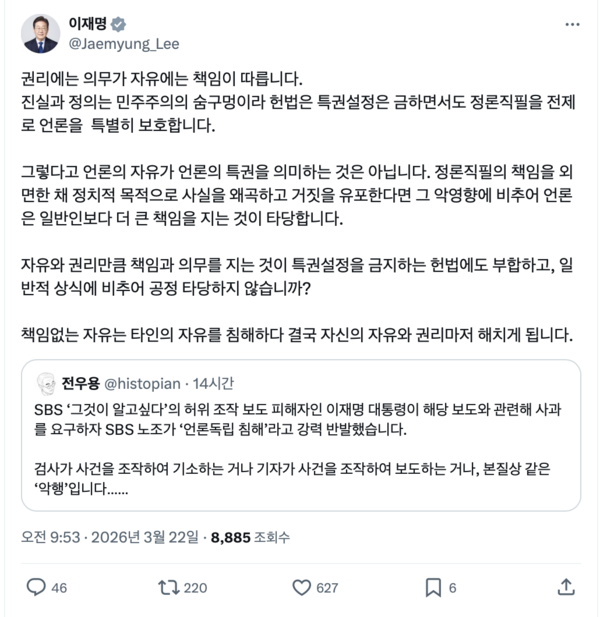
President Lee shared on social media a Facebook post by left-leaning commentator and historian Jeon Woo-yong, which criticized the SBS union.
Jeon’s post stated that “whether a prosecutor fabricates a case to indict or a journalist fabricates a case to report, both are essentially the same ‘evil act.’ The belief that they should be exempt from accountability even when committing wrongdoing has been the shared ideological foundation sustaining the ‘legal-media vested-interest cartel.’” He further argued that “before condemning the president, the SBS union should reflect on why the prosecution dictatorship under Yoon Suk Yeol did not order power and water cuts to SBS.”
Sharing this post, President Lee criticized the SBS union, saying, “Freedom of the press does not mean privilege for the press.”
He continued, “Truth and justice are the lifeblood of democracy. While the Constitution prohibits the establishment of privileges, it specially protects the press on the premise of fair and truthful reporting.” He added, “However, press freedom does not equate to press privilege.”
The president argued that “if the responsibility of fair and truthful reporting is neglected and facts are distorted or falsehoods spread for political purposes, then, given the harm caused, the media should bear greater responsibility than ordinary individuals.”
He further stated, “Bearing responsibility and duty alongside freedom and rights aligns with the Constitution, which prohibits privileges, and is fair and reasonable by common standards.” He added, “Freedom without responsibility infringes upon others’ freedom and ultimately harms one’s own freedom and rights.”
However, in this newspaper’s view, the counterattack by President Lee and Jeon Woo-yong appears to involve logical leaps or misaligned facts.
Attention is now focused on how the SBS union will respond.
Meanwhile, the SBS union had earlier criticized the president, stating that he “distorted facts and portrayed SBS and ‘Unanswered Questions’ as if they were mobilized by a specific political force.”
The union argued that although attorney Jang Young-ha, who spread allegations of Lee’s alleged ties to organized crime, was found guilty by the Supreme Court on March 13, the SBS program did not merely repeat his claims. Instead, it reported findings uncovered earlier during investigations into the Pattaya murder case.
The union emphasized that “the allegations had already been raised by other media outlets prior to the broadcast, and the program’s role was to bring them into public discourse and verify them.” It added that this was part of journalism’s core function of scrutinizing public figures and was unrelated in both timing and substance to Jang’s claims.
The union also criticized the president for “singling out an individual producer and citing inaccurate career details at length,” suggesting that it may have been an attempt to direct supporters toward a target.
It further warned that “every statement from the president and the presidential office toward the press can shrink press freedom and threaten independence,” and pointed out what it described as a double standard—praising the media when favorable, but condemning it as “fabricated” when unfavorable.
The union concluded by urging the president to stop pressuring the media through demands for apology and to refrain from statements that could undermine press freedom, adding that SBS journalists would continue reporting without yielding to political pressure.
#PressFreedom #MediaVsGovernment #FreedomAndResponsibility