

[Choice Times=Jae-Il Yoo, hardline political commentator]
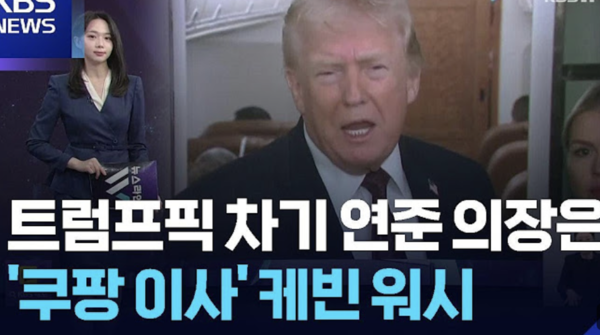
When Coupang’s outside director Kevin Warsh was nominated as chair of the Federal Reserve, every pressure campaign the South Korean government had been mounting against Coupang came to an immediate halt. The so-called “Coupang Rectification TF” even changed its name and was postponed indefinitely. These fools had ignored repeated warnings to stop pressing Coupang—and now look at them.
Pressure on Pastor Son Hyun-bo, who was imprisoned and released not long ago, should also have been stopped at once. The moment Vice President JD Vance uttered Son Hyun-bo’s name, Prime Minister Kim Min-seok should have said “Yes, understood,” instead of launching into rambling explanations.
Isn’t that too submissive? Then what’s the alternative? When it’s a tsunami, you avoid it—you don’t try to stand your ground. If there were an engineering solution to confront a tsunami, then by all means confront it. But humanity has no such engineering feat. The South Korean government likewise has no political-engineering solution to confront a Trump-driven tsunami. In that case, you say “Yes” and move on.
What I have confirmed through this episode is that South Korea’s Democratic Party government has no basic understanding of Trump’s political faction.
At its core, the Trump leadership has a “Big Three”: JD Vance,Susie Wiles, andDonald Trump Jr.. Of these, Trump Jr. is the one to watch most closely.
Vance is a 41-year-old vice president. Wiles is like a dormitory matron who enforces discipline and loyalty across the administration. The overall coordinator of behind-the-scenes lobbying and alignment is Trump Jr.
You have to pay attention to the fact that Trump Jr. holds no official title. That means there are no limits on whom he can meet and no limits on his political discretion. As the son who inherited the Trump name, he wields virtually unlimited latitude, exerting enormous influence through back-channel negotiations and bargaining.
The Trump leadership’s “Big Three” are managers of power. Beneath them are figures who oversee specific domains.
Marco Rubi omanages foreign policy; Mike Walt zoversees pressure on China; and Tulsi Gabbard commands intelligence and cognitive warfare.
Elon Musk is emblematic. Seeking federal efficiency, he dismantles departments deemed wasteful, fires civil servants, and moves to tear down organizations and regulations. If Vivek Ramaswamy and Musk—who co-headed the Department of Government Efficiency—attack the administrative state, Russell Vought clamps down on the budget to subdue and control the bureaucracy. Vought is a core figure behind Project 2025, produced by the Heritage Foundation, which supplied the Trump government’s blueprint and personnel.
Hardly anyone is paying attention to the fact that one of the working-level authors for Project 2025’s foreign and security section is Moss Tan. His conspiracy theories about Chinese interference in U.S. elections may be absurd—but the connection between him and the Project 2025 foreign-security line is real. We must look at reality coolly. Only by facing the foreign-security environment surrounding South Korea as it is can we survive.
Coupang is an American company. It can openly spend political money in the United States. Based on reporting to date, Coupang has spent $10.75 million since listing. It donated $1 million to Trump’s inauguration and carries out strategic giving through its own PAC (COUPAC).
The cost of hiring Kevin Warsh—now nominated as Fed chair—as an outside director is not included in those lobbying totals. How much Coupang has spent on broad lobbying—by employing or doing business with people capable of influencing U.S. politics—remains unknown.
Coupang has spent lobbying funds across the board at the White House National Security Council, the State Department, the Commerce Department, the U.S. Trade Representative (USTR), and both chambers of Congress, with a recent focus on the USTR.
The key pro-Coupang lobbying channel is Robert O'Brien, who succeeded John Bolton as national security adviser in Trump’s first term. He currently chairs a strategic consulting firm, American Global Strategies, which advises companies on geopolitical risk and the government policy and regulatory environment. Coupang is a major client.
O’Brien co-founded the boutique law firm Larson with former federal judge Stephen Larson and is now an honorary partner. The structure is such that American Global Strategies handles consulting and lobbying, and if matters proceed to litigation, the Larson firm steps in.
O’Brien entered the Coupang controversy by publishing an opinion piece directly criticizing South Korea’s Fair Trade Commission investigation into Coupang. His argument was that “Korea’s regulation discriminates against an American innovative company (Coupang), thereby weakening the economic foundation of the U.S.–Korea alliance.”
He sent multiple signals that pressure on Coupang could turn into a U.S.–Korea trade dispute—and lobbied bodies such as the USTR to make it so.
Ultimately, one of the Trump leadership’s Big Three—JD Vance—delivered a message to Prime Minister Kim Min-seok that the U.S. was “closely watching the Coupang issue.”
To explain why JD Vance spoke about both Coupang and Pastor Son Hyun-bo at the same time, we must assume a prior coordination phase before Vance—namely, through Trump Jr.
Trump Jr. bundled two lines—the Project 2025 group’s connections with the Korean right and the Coupang connection that came in via O’Brien—and passed them to JD Vance, who then conveyed them to Kim Min-seok, setting events in motion.
Completely unaware of how this lobbying machine was operating, Prime Minister Kim Min-seok of the Lee Jae-myung government misread the room, proclaimed that “Coupang is an anti-American bad company,” and the very next day got hit with 25% tariffs. Only after Kevin Warsh’s nomination as Fed chair did the Korean government finally grasp the situation.
They scrapped the Coupang TF—what on earth have they been doing? Even now, the Korean government still doesn’t seem to understand what’s going on. These days, it really feels like South Korean politics is utterly incompetent at managing situations.
#CoupangCrisis #USKoreaRelations #PoliticalMiscalculation