

Let us scan his record with common sense
[Choice Times=Joo-hyun Park, CEO of Jae-Dam Entertainment]
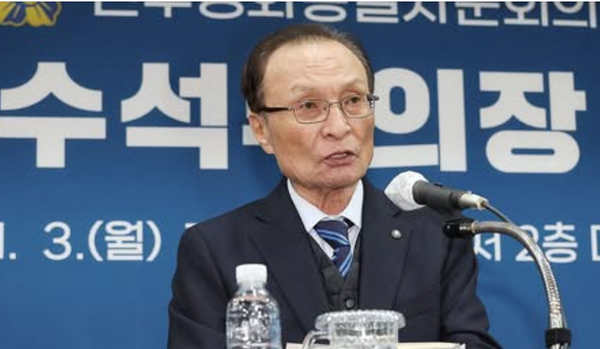
The funeral of Lee Hae-chan, Senior Vice Chair of the National Unification Advisory Council (NUAC), will be held from January 27 to 31 as an institutional and social funeral. It was previously reported that the Ministry of the Interior and Safety had considered holding a state funeral.
On the 26th, the NUAC announced that it would jointly host the funeral with the Democratic Party.
An “institutional funeral” is conducted by the organization to which the deceased belonged, while a “social funeral” is a ceremony held when a prominent figure who made contributions to the state and society passes away, with representatives from various sectors voluntarily forming a funeral committee.
Lee’s body is scheduled to arrive at Incheon International Airport on the morning of the 27th and be transported to the funeral hall at Seoul National University Hospital. (Editor’s note)
Death is a biological full stop. Praying for the repose of the dead as a human being and absolving, as a sovereign citizen, the political debts he left behind belong to entirely different realms. Yet news emerged that the Ministry of the Interior and Safety was considering a state funeral (after this article was written, it was finalized as an institutional and social funeral). This is less an act of mourning than a form of “state-sponsored gaslighting” that pressures society to forget.
Let us scan his record with common sense. He was not merely a politician. He was the architect of educational destruction who gave rise to the so-called “Lee Hae-chan generation,” encapsulated in the self-mocking cry of having the “lowest academic standards since the founding of the nation.” That generation, kicked off the ladder by the misguided ideology of downward leveling, is today in its early to mid-40s—the so-called “Young-Forties”—forming the backbone of society, eyes wide open.
The attitude he displayed during his tenure as prime minister was closer to the arrogance of a feudal lord than that of a public servant. When massive wildfires ravaged Gangwon Province and floods struck the country—and even on the symbolic March 1 Independence Movement Day—he was swinging golf clubs with business leaders. The memory of that “imperial golf,” where his personal round mattered more than national suffering or symbolism, remains vivid.
What about the controversy over his designation as a May 18 democratization merit awardee? A peculiar narrative in which he was not present at the Gwangju scene, yet became an awardee nonetheless. Whether this was a just recognition of the blood shed in May 1980, or merely the “sharing of spoils” within an activist cartel, remains an open question. Add to this his habitual verbal abuse, shouting, and rigid, domineering demeanor.
Everyone knows that the NL faction occupies key posts, but pushing ahead now with a large-scale funeral and memorial altars is the worst possible self-inflicted wound that only demeans the deceased. Had he been sent off quietly, people might have said, “He was still a heavyweight of his era,” and moved on. But the moment they force fanfare and attempt to package him as a great figure, they compel the public to rewatch—against their will—the “chronicle of arrogance” they had forgotten or never known.
The louder the volume of commemoration, the sharper the resolution of his failures becomes. If the NL camp had even a shred of political sensibility, it would have chosen a quiet exit into the back pages of history, rather than this noisy spectacle.
An “arranged” or coerced mourning is not commemoration; it is nothing more than a posthumous dissection that re-briefs the nation on the deceased’s flaws. Is it not an unbearably cruel calculus to turn even the final journey of the leader they once served into a tool for flaunting political muscle?
They may believe that this lavish funeral will add to his glory. But to the public eye, it looks merely like a “final alumni reunion of hypocrites,” paid for with taxpayers’ money.
#StateFuneralDebate #PoliticalLegacy #ContestedMourning