

“The ‘Anti-State Forces’ Turn Out to Be You”
[Choice Times=Bo-Sik Choi, Publisher]
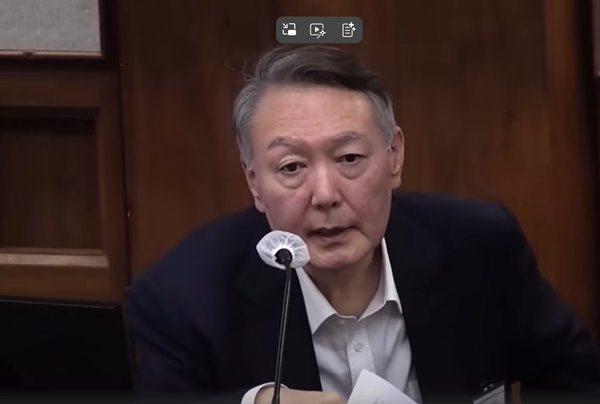
Everything is proceeding along a predetermined course. The game was already over, regardless of how former president Yoon Suk-yeol, his lawyers, or his supporters protest or complain.
Former president Yoon, who has been indicted on charges of being the ringleader of an insurrection, has been formally sought the maximum penalty under the law: death.
For the crime of leading an insurrection, the range of punishment is limited to three options—death, life imprisonment, or life imprisonment without hard labor (a sentence that has virtually fallen into disuse). Given the excessive—some might say overzealous—posture displayed by special prosecutor Cho Eun-seok throughout the investigation, a request for the death penalty was widely anticipated.
On the 13th, the special prosecutor’s team led by Cho Eun-seok appeared at the sentencing hearing before the 25th Criminal Division of the Seoul Central District Court, presided over by Judge Ji Gwi-yeon. The prosecution argued that the December 3 emergency martial law declaration constituted “a grave destruction of the constitutional order carried out by anti-state forces,” and requested that the court sentence Yoon, identified as the ringleader, to death.
The team further urged the court to punish “the constitutional order–destroying acts committed by elite public officials more severely than the historical reckoning imposed on the forces of Chun Doo-hwan and Roh Tae-woo.”
In effect, the special prosecutors took the very phrase Yoon had used to justify the declaration of martial law—“the eradication of anti-state forces”—and affixed the label “anti-state forces” squarely onto Yoon himself.
When declaring martial law on December 3, Yoon stated, “I will 반드시 eradicate the anti-state forces, the prime culprits behind the nation’s ruin who have engaged in relentless acts of misconduct,” explicitly identifying the then-opposition Democratic Party, which he accused of serial impeachments, legislative dictatorship, and budget cuts, as anti-state forces.
At the sentencing hearing, however, the special prosecutor’s team asserted that the true “anti-state forces” were, in fact, Yoon himself.
Special Prosecutor Park Eok-soo stated, “This case clearly reveals who the so-called ‘anti-state forces,’ invoked by the defendants as their justification, truly were.” He continued, “The armed intrusion into the National Assembly and the National Election Commission, as well as attempts to cut electricity and water supplies to media outlets, constitute a grave destruction of the constitutional order by anti-state forces—an episode without precedent in our constitutional history.”
Park further argued that the defendants used emergency martial law as a means to usurp legislative and judicial authority, monopolize power, and pursue long-term rule driven purely by a desire for power. “These acts directly and fundamentally infringed upon national security and the survival and freedom of the people,” he said, adding that “in light of their purpose, means, and manner of execution, they bear the character of ‘anti-state activities’ as regulated under the National Security Act.”
He went on to say that immediately after the declaration of martial law, the public recalled the memories of the 1980 emergency martial law and power seizure carried out by the forces of Chun Doo-hwan and Roh Tae-woo, expressing extreme anxiety and anger. “This incident spread throughout society a sense of crisis—that the democratic and rule-of-law achievements painstakingly built by South Korea could collapse in an instant,” Park said.
Park emphasized that the crime was committed solely for the defendant’s monopoly of power and ambition for long-term rule, mobilizing human and material resources—such as the military and police—that should be used exclusively for the benefit of the state and the community. “The gravity of the offense is therefore extremely severe,” he said. He also criticized Yoon for shifting blame for the declaration of martial law onto the opposition and advancing implausible claims such as a “warning-type” or “appeal-type” martial law, further infuriating the public.
“There are absolutely no mitigating factors worthy of consideration,” Park added. “In South Korea’s criminal justice system, the death penalty does not merely signify execution. It functions as a means by which the community, through judicial process, manifests its resolve to respond to crime and its trust in that response.”
The court will deliver its verdict on February 19, the date on which Yoon’s fate will be finally decided. In practical terms, there is little room for maneuver left to the presiding judge.
The sentence handed down by the court is unlikely to deviate significantly from the prosecution’s request. At most, it could be reduced to life imprisonment.
Although extremely unlikely, if the court were to acquit Yoon of the insurrection charges, the political landscape would be thrown into turmoil, and the possibility of impeachment of the judiciary itself would rise sharply.
This marks the first time since 1996, following the case of former president Chun Doo-hwan, that the death penalty has been sought against a former president on charges of insurrection. At that time, the court ultimately sentenced Chun to life imprisonment.
#DeathPenalty #InsurrectionTrial #RuleOfLaw