

[Choice Times=Joo-hyun Park, CEO of Jaedam Entertainment]
The article below does not represent the position of this newspaper. It is published to present diverse perspectives. (Editor)
In all my years of living, I never imagined I would hear a president described as having become a “prison idol.”
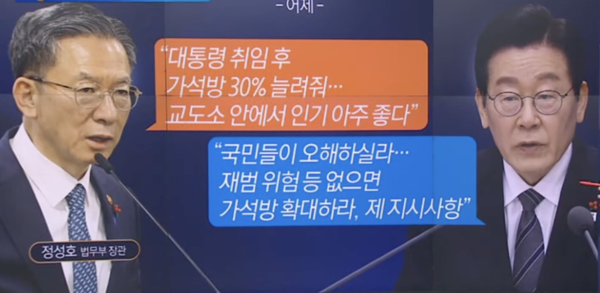
Did you see the news? Justice Minister Jeong Seong-ho stood there smiling brightly and said this to President Lee Jae-myung:
“Mr. President, you’re extremely popular inside prisons.”
At first, I wondered what on earth that was supposed to mean. Apparently, since taking office, he has dramatically increased parole by 30 percent, and the incarcerated population is cheering enthusiastically.
Wow—so is that actually a compliment? Normally, wouldn’t a president be praised for being popular withthe public? Instead, he’s being criticized by people who live law-abiding, diligent lives, while receiving seal-like applause from those who broke the law and ended up behind bars. Is this noir, or is it a sitcom?
The president went even further, hammering the point home by saying, “If there’s no risk of reoffending, expand parole—this is my instruction.” He says it as if he’s generously opening the doors, but once you look at the reality behind it, it’s genuinely staggering.
Prisons are bursting at the seams. Occupancy rates exceed 120–130 percent, with inmates complaining there’s nowhere to sleep. (In 2022, the average occupancy rate of general prisons was already 105.8 percent.)
How did it get this bad? It’s the massive own goal kicked off by the Democratic Party’s so-called “complete stripping of prosecutorial powers.” By tearing apart and weakening investigative authority, investigations are delayed and trials drag on endlessly. As a result, pre-trial detainees who haven’t even been sentenced pile up in detention centers, turning correctional facilities into “human logistics warehouses.” After severing the arteries of the justice system, they now stand there bewildered, saying, “There are too many people to manage”?
What’s even more outrageous is the situation of correctional officers. This is not a joke. Overtime pay for prison officers is not being paid on time. The reason is absurd: because the inmate population has exploded, the budget has been blown on feeding prisoners and covering their medical costs, and money was diverted from what should have gone to officers who work through the night.
This is the reality of South Korea in 2025. Public servants who guard criminals have their pay docked, while criminals are fed three full meals a day with that money—and as if that weren’t enough, the president even opens the doors and tells them to go home early. Is human rights now a selective premium option applied only to criminals?
President Lee’s solutions are always like this. When sewage backs up because the pipes are clogged, instead of fixing the pipes, he proposes dumping the sewage out into the street. It’s the easiest option—and above all, the secret to staying popular with criminals.
Minister Jeong, and Mr. President—this is not the time to grin about being popular in prisons. The louder the applause inside those walls, the more the tears of victims outside them turn into rivers.
Be sure to write it into your memoir later: “A leader loved by criminals.” It’s a bitterly comic title that will live long in history.
#PrisonPolicy #ParoleControversy #PoliticalSatire