

nstead, the Lee Jae-myung government is not persuading the public at all
[Choice Timex=Soo-Young Park, National Assembly Member (People Power Party)]
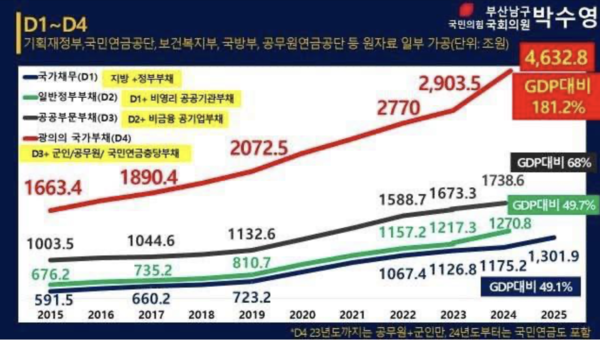
Today, I will state clearly and precisely how much real national debt South Korea is carrying.
As of the end of 2024, Korea’s total debt stands at 4,632 trillion won, equivalent to a staggering 181% of GDP, according to figures compiled by a lawmaker’s office. This is the so-called D4 “broad” measure of national debt, which adds unfunded liabilities of the National Pension (1,575 trillion won), provisions for the Military Pension (267 trillion won), and provisions for the Civil Servants’ Pension (1,052 trillion won) to the public-sector debt (D3) of 1,738 trillion won announced by the Ministry of Economy and Finance last week.
The government discloses only D1 (central and local government debt), D2 (which includes non-profit public institutions), and D3 (which also includes non-financial public enterprises). None of these, however, adequately reflect Korea’s reality. By law, the state is responsible for pension obligations. If the government is to properly inform the public of how much debt the state is truly carrying, it must transparently disclose the full D4 figure—4,632 trillion won.
The government should frankly tell the public that “each citizen already carries debt of 89.63 million won; a baby is born owing nearly 90 million won; and the reality is that even heavier debt is being passed on to future generations,” and then design fiscal policy accordingly.
Instead, the Lee Jae-myung government is not persuading the public at all. It has even abandoned the fiscal discipline framework of the Yoon Suk-yeol administration and is recklessly pumping money into the economy. President Lee Jae-myung said during last week’s Ministry of Economy and Finance briefing that “for the time being, expansionary fiscal policy is unavoidable.” There are growing concerns that, with elections approaching next year, the government will again resort to cash handouts in the form of so-called “livelihood coupons.”
But the damage caused by populism is already unfolding. Because of the nationwide 250,000-won cash handout—like pouring water onto sand—both Seoul and Gyeonggi Province have already carried out large-scale restructuring of next year’s welfare budgets. Due to indiscriminate expansionary spending, the value of the won has plunged, pushing domestic fuel prices sky-high even as international oil prices fall. Prices of all kinds of raw materials have risen, leaving people afraid not only to dine out but even to shop for groceries. Companies are sharply cutting investment, especially hiring.
Does President Lee Jae-myung not see the crumbling Korean economy and the massive burden of debt being piled onto our children’s shoulders? International organizations such as the IMF and OECD have repeatedly warned about Korea’s rapidly rising debt. Taiwan’s case—now drawing attention—shows a strict fiscal rule that has reduced its government debt (D2) to 23% of GDP, roughly half of Korea’s level. Because of “Lee Jae-myung–style populism,” the sound of Korea’s declining national competitiveness is spreading around the world.
President Lee Jae-myung should feel ashamed before the people. This is not the time to live-broadcast personal insults and divisive attacks against heads of public institutions appointed by the previous administration, exposing one’s own ignorance on camera. Enough with the show. Address the national debt and the economic crisis facing Korea.
#NationalDebtCrisis #FiscalPopulism #KoreanEconomy